Walking in Kaiserslautern
Grief, memory, and becoming Real


In early summer, an educational requirement for one of my children took the two of us to Germany, which from our home in the most northern bit of France is a five-ish hour drive across four countries. Don’t be fooled—it’s a wildly boring journey, except a couple of river views in the Ardennes and on the Luxembourg-Germany border, and where the speed limit disappears thereabouts. We stayed in the region of Rheinland-Pfalz in a 150-year-old family-owned hotel outside of the town of Kaiserslautern. I’d estimate that that means nothing to about a third of you, so: for decades this has been a major hub of U.S. forces in Europe, and there are many military instillations big and small in the surrounding area. Shout-out to the good folks at the Stars and Stripes and AFN for treating my daughter so well, including putting her on live radio. They also gave her copious amounts of Air Force swag, which I suspect had a belligerent undertone as she’s a third-generation Army brat. Anyway, while she was interning, I was determined to spend my days lounging in the heatwave at the local outdoor pools (a luxury to those of us in the north of France! Not that the climates are wildly different—perhaps it’s the locals’ constitutions, or folk beliefs about what will make you ill), reading, writing, and walking in the lovely forested hills. I didn’t entirely succeed due to being hormonal, sluggish, and not in the mood to figure out new things or pay money for intense hiking websites when I was in search of a gentle stroll.1
I eventually drove past a promising-looking spot with a parking lot. Parking is key for it being a “gentle stroll”—if I have to walk to your walk then the sandglass is already running. I found my way back to it one morning. Following the path toward the woods, I met a bleak tunnel under train tracks. Beyond it, greenery stretched uphill. Above the entrance was engraved 2018.
This wasn’t subtle. My 2018 contained some real lows, and something had recently caused me to relive them and ruminate on the path my life has followed since. The years of miscarriages and illness from 2015-2017 didn’t erupt into a bright, easy, redemptive 2018. The darkness was different, and still so close. And here I was presented, smack on the nose, with a literal tunnel labelled 2018 for my strolling pleasure. (Yes, I often wish I were the kind of person who didn’t notice these things.) A wry smile and some reverberating humming got me through. On the other side I found a sweet fountain with bathing birds and a steep-for-me path that I walked up, immersed in a proper forest for the first time in I don’t know how long. Several, even many years. At the top of the hill, shafts of canopy-filtered sunlight illuminated butterflies visiting blackberry blossoms, and the birds sang with that woodland assurance that just sounds different, despite the roaring of a train down the hill and cargo planes overhead. Passing through the tunnel on my way out, I cried instead of smiling. It always hits you later. Or, that’s the way it works for me.
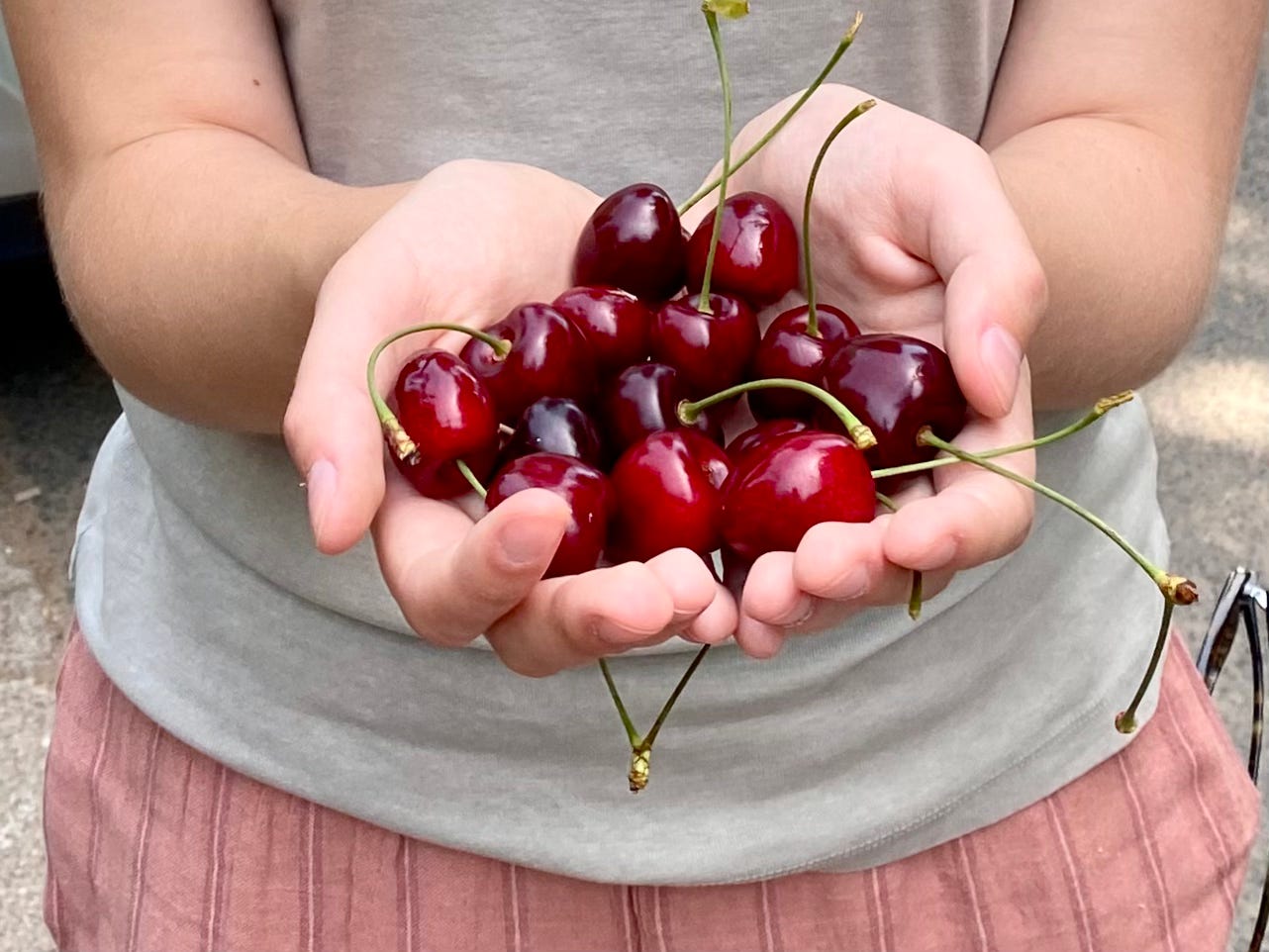
Every tree and shrub burgeoned into explosive growth in the very warm weather, and this corner of the middle of Germany had a tropical flavor for just these few days. In the evening outside of our hotel, the trees loomed, their greenery and that sprouting below filling the drooping air with complex aromas of accelerated decay and growth. A few ripe raspberries dotted planters; it was cherry season, and the courtyard trees were heavy laden. We messily devoured a carton of them during my daughter’s lunch break.
The other notable walk I took was through the Hauptfriedhof Kaiserslautern, the town’s main cemetery. The day was cooler than the week’s average, with a flat light gray sky. I don’t know if it is typical in Germany, but this cemetery has the feel of a gently overgrown garden. Tall trees keep company with the dead, sheltering headstones and shading the tiny garden patches into which many graves are turned.2 Roses climb, angels rest, ivy covers. I didn’t see a single fake flower.
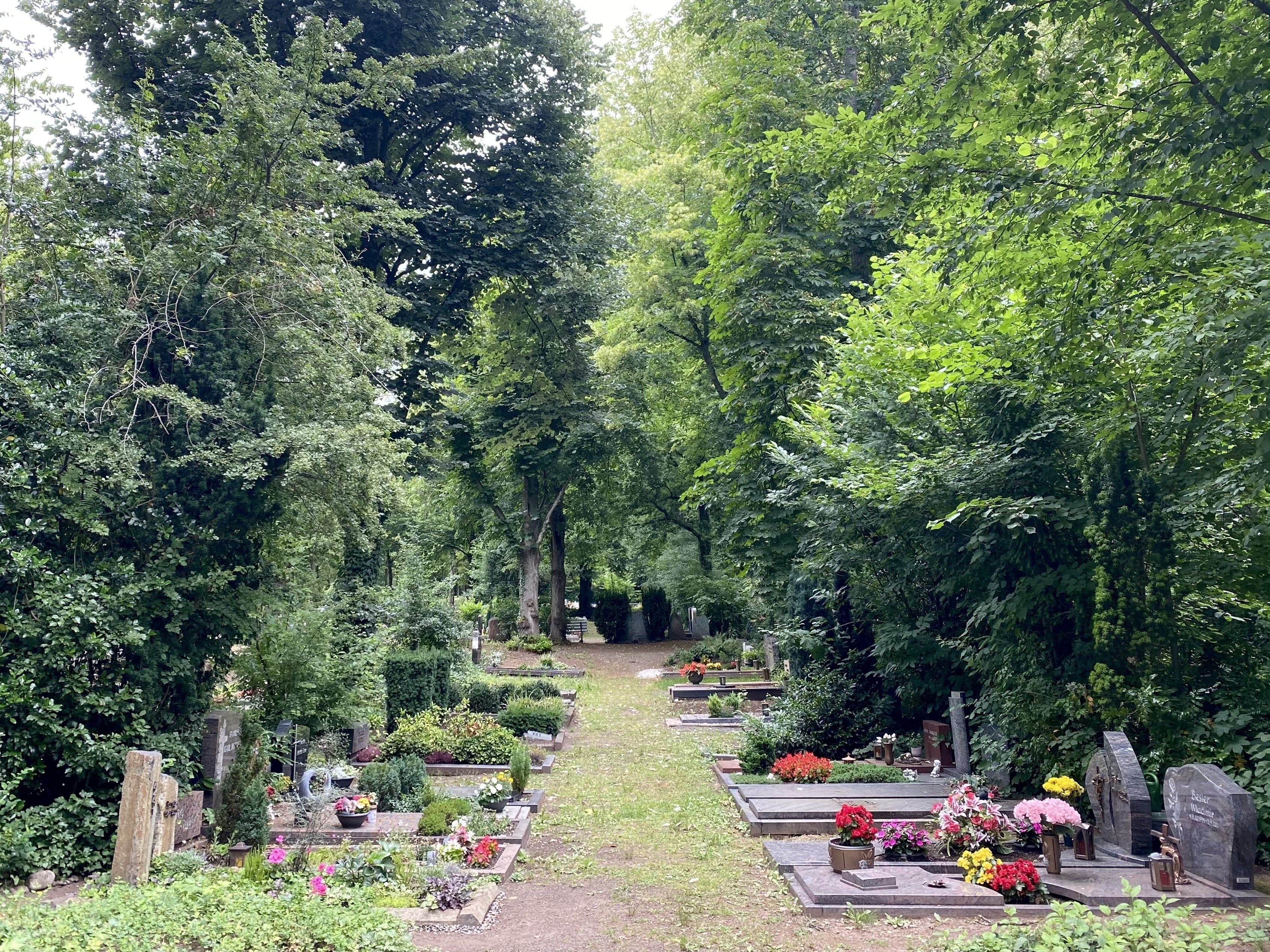
I prefer to wander through cemeteries and read names and inscriptions and imagine lives, but I had somewhere to be. I passed old and new graves, with Alpha & Omegas, with Stars of David. An opera singer’s grave bore musical notes and a lyre. I did pause to greet a red squirrel. They are usually painfully shy, a burnt sienna flash far up a tree. This little one sat right out on a rock by the path, peering at me with loquacious eyes. He snacked on seeds spread on a rock. I passed one or two ladies on the older end of middle age, that time when you start losing people unexpectedly. I was going to the Kindergraves.
While scrolling through Google Maps, scouting ways to divert myself while my daughter labored at her internship, I thought I’d spotted a large city park until an unsettling marker popped up: American Kindergraves. It is what it sounds like. Its story is one of memory-keeping and honoring the youngest among the dead.
Life feels more obviously ephemeral when you’re in a military family. You have no roots, dear friends slip quickly in and out of your life, you can’t remember what state or country you lived in when such-and-such happened. Maybe you joined up (to the service or to the marriage) because you desperately wanted to escape where you were, with no idea of where you wanted to end up. Maybe, back then, you were drafted when the world was at war. Perhaps you were deployed to Europe, or your father was, and you know first or secondhand the destruction that roiled up from the ground here, rolled along the train tracks, then was rained down from the sky, and now you’re back here for a time learning German and living peaceably. In this foreign place you have a baby, and the baby dies. After all that you’ve survived and had and lost, maybe the losing of this little one is what finally destroys you. Or perhaps you soldier on, filing it away with the rest of the horrors. You bury him in West German ground, not entirely unlike the American soldiers who lie beneath white crosses all over Europe. Maybe husband and wife turned toward each other, or maybe the risk feels too great, the gash too deep. Maybe you keep his picture where it can be seen, and his siblings know of him, or maybe you bury the memory in whatever vice works best for you and all that’s left is an unspoken name on a small plaque under a tree. One day you move home across the ocean and never come back.
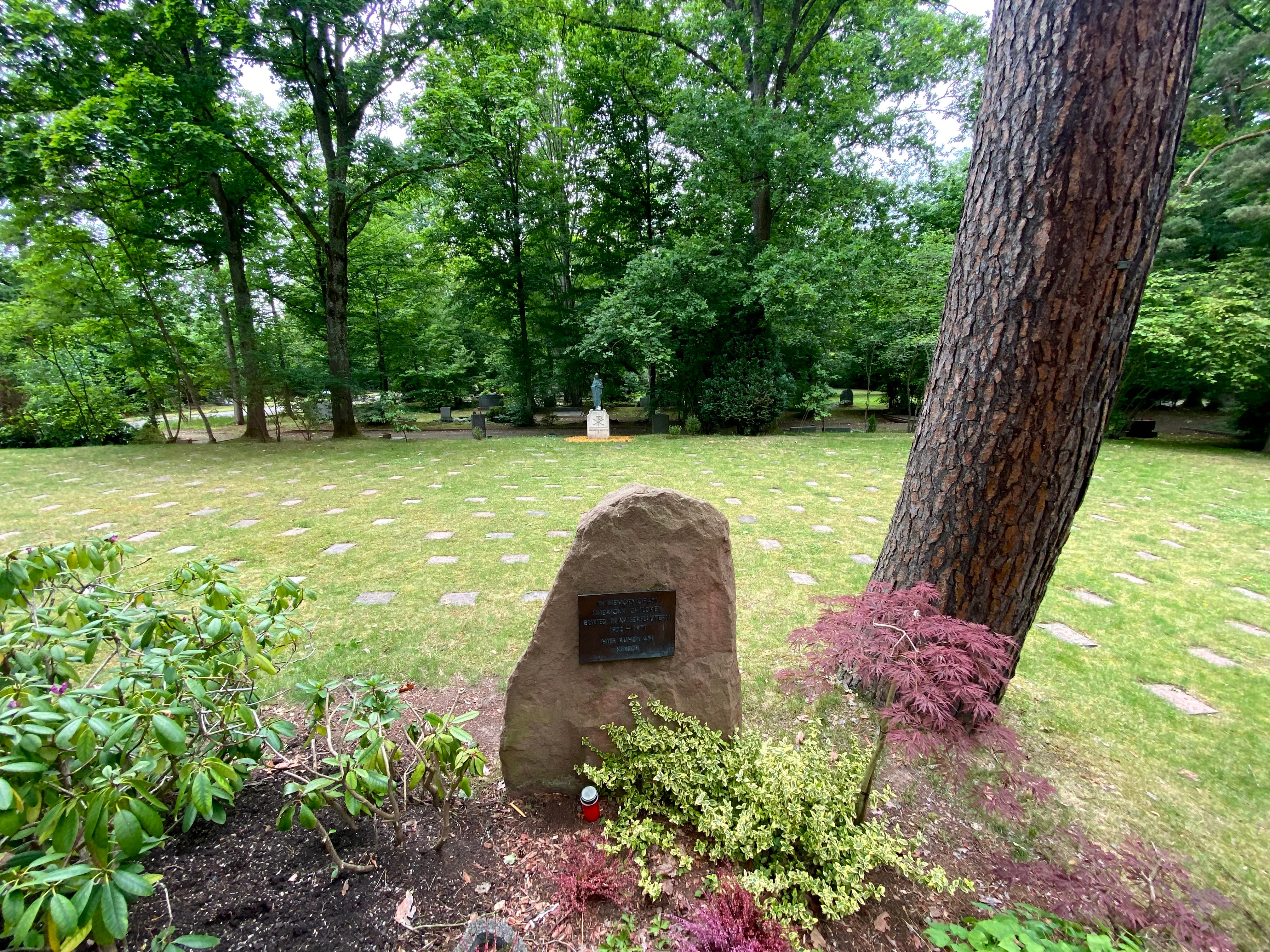
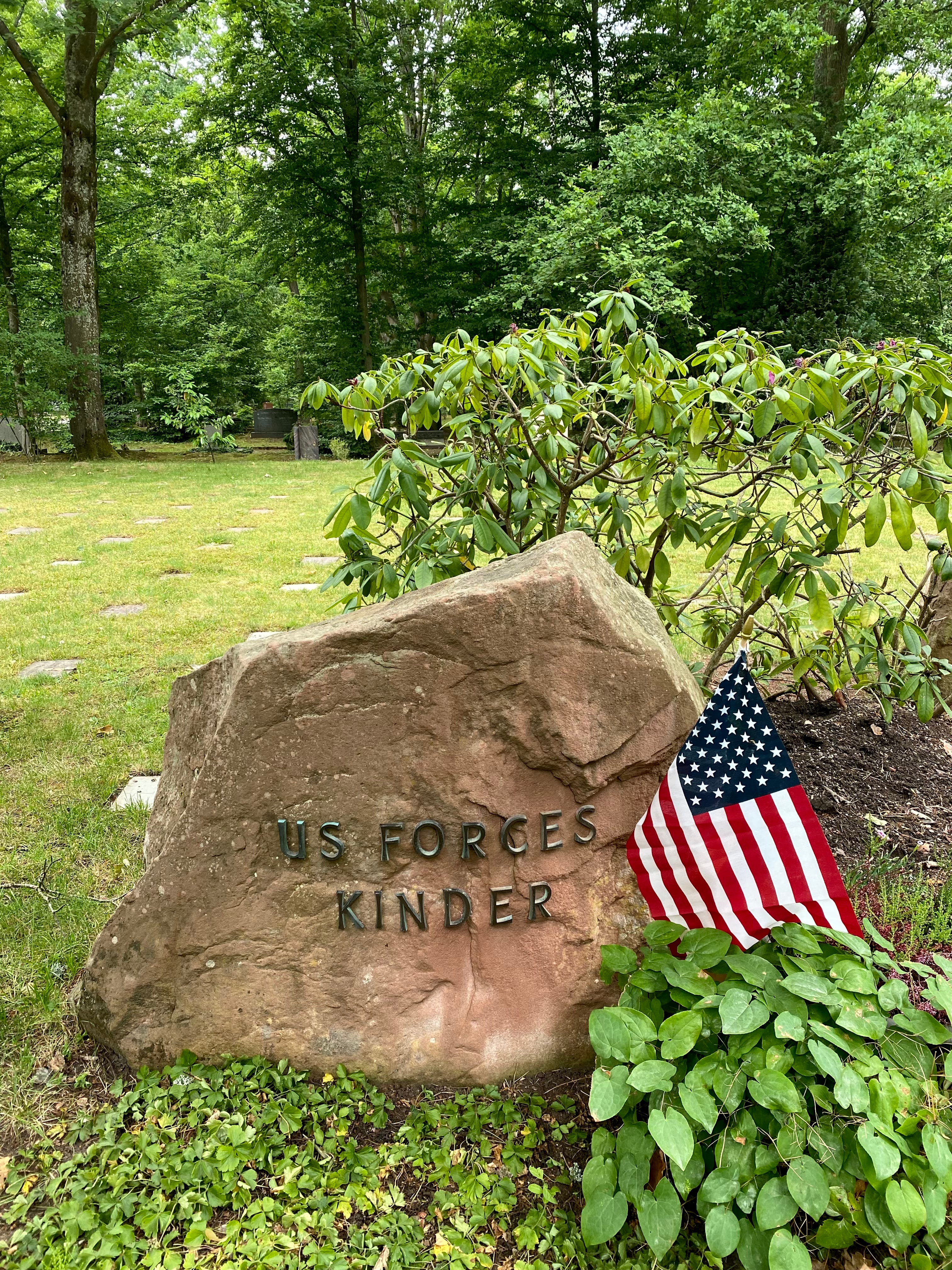
Today the Kindergraves have been collected in a clearing, its grass short and monoculture in a fittingly military way. Buried here are 451 infants and children of U.S. service members who died in Kaiserslautern between 1952 and 1971. Most of them were younger than 3 months of age. The city donated two cites within the cemetery for the graves. There isn’t a lot of land in Europe, so after a certain number of years the custom is to move what remains and reuse the land. That was going to happen here in 1980, but members of the German-American Women’s Club who had served as caretakers advocated for a different solution. Since then, the Ramstein Area Chief’s Group leases the land, funded by donations from the local community. “The cemetery management agreed to move the gravesites to a new area in the heart of the cemetery,” and they are now maintained by the Kaiserslautern Kindergraves Memorial Foundation, along with the Ramstein Area Chief’s Group, the German-American Women’s Club, the International Women’s Club, and budding Eagle Scouts. Born to a life that slipped through fingers and given a resting place that was far from final, the children were eventually given an enduring place in the land.
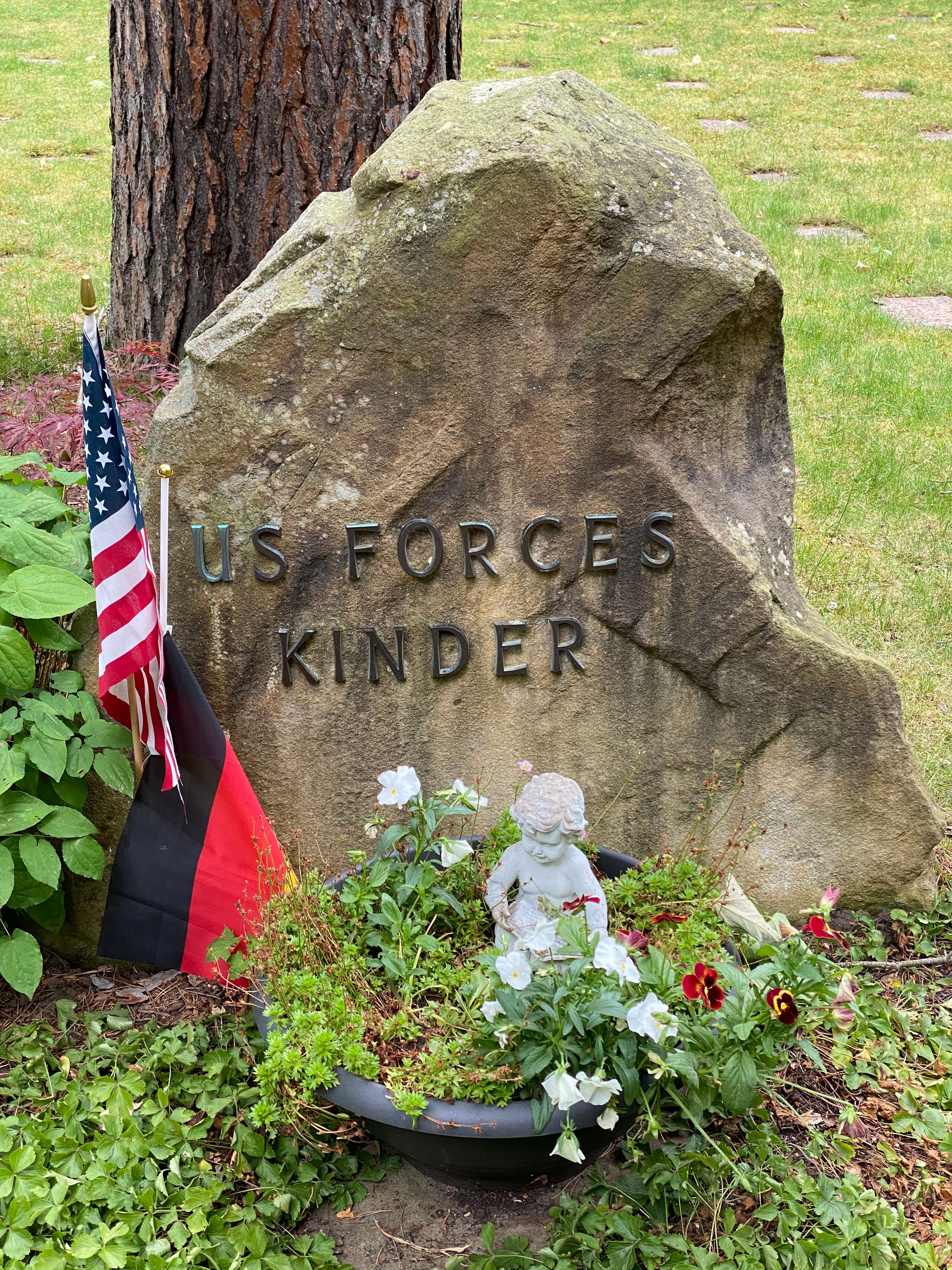
Standing in front of hundreds of little grave markers, it looked like an atrocity had been committed. But it hadn’t; it was just life in a time before the vaccines, treatments, knowledge, and control that we have now. Life before it was realistic to ship remains back home when a military family member dies overseas. American and German flags leaning together decorate the plantings alongside the plot. A Mother and Child kept watch. I cried for the little ones and for the mothers and fathers who must have felt so lost leaving without them. I know how that feels. Maybe it’s one reason we’re still in Europe after all this time.
In the cemetery, I thought about how late in the winter of this year, we lost the youngest and oldest members of our family. They were separated in age by more than ninety years; both were beloved, treasured, and fought for. Under a brilliant blue Virginia sky, the boys and men of my family filled in my smallest nephew’s grave. There are unfillable holes left in the fabric of those who share our blood and our love. I know that the holes will not disappear, but they’ll heal, and the scars will be treasures. And one day, one day…
But it changed me. And I’m tired of being changed. I’m deep in the velveteen phase of being made Real; I’m becoming shabby, my hair is falling out, my joints are popping out, and my boot-button eyes have lost their luster and become wise. I long for the day when I become really Real and am home at last.
Although I’ve never lived there, I have the kind of ties to Germany that many in America’s so-called warrior class do. My grandfather fought there, then lived there with the family when my mother was small; my parents lived there when my older sister was born. Bits of the language were tossed into our funny mix of lexicons that military families pick up, a small linguistic reminder of the greatest tearing down and rebuilding of the modern era, and of the cultural entwining that followed. That week that I sojourned in the same land where my ancestors had, I was deeply encouraged by Sarah Clarkson’s words. Please read the whole thing.
Thus, I was reading the passage yesterday where Frodo wakes in Elrond’s house after his ordeal of being stabbed on Weathertop, pursued by Black Riders, and nearly claimed by the wraith world at the Ford of Bruinen. He finds Gandalf watching him, and Tolkien allows us to see Frodo through Gandalf’s eyes. The hobbit looks ‘as it were’, transparent, a description that gestures to his recent danger of becoming transparent like a wraith. One feels that descriptor, transparency, as a threat.
But then, unexpectedly, Gandalf pivots and begins to muse that though he cannot see Frodo’s end, he does not believe it will be evil, and perhaps Frodo’s transparency will become a beautiful thing:
He may become like a glass filled with a clean light for eyes to see that can.
And my eyes burned with tears.
In that subtle shift from Frodo’s ordeal as something that threatens to destroy him, to something that renders him tested and clear, his soul filled with crystalline light, I see all the promises of God’s healing love at work among us in a suffering world. …
…I began to wonder if perhaps the medicine of Christ’s great love at work in me…means that though grief and doubt and loss are still mine to bear as I wait for the renewal of the world, my own ordeal, my own suffering (and that of my children) will not ultimately unravel us, but rather gradually leave us with hearts swept clean of anything but hope, but love. I think it will take awhile.
How long? As a church musician, I’m preparing for Advent (and already behind). I find myself returning to this song and feeling it even more keenly than last year.
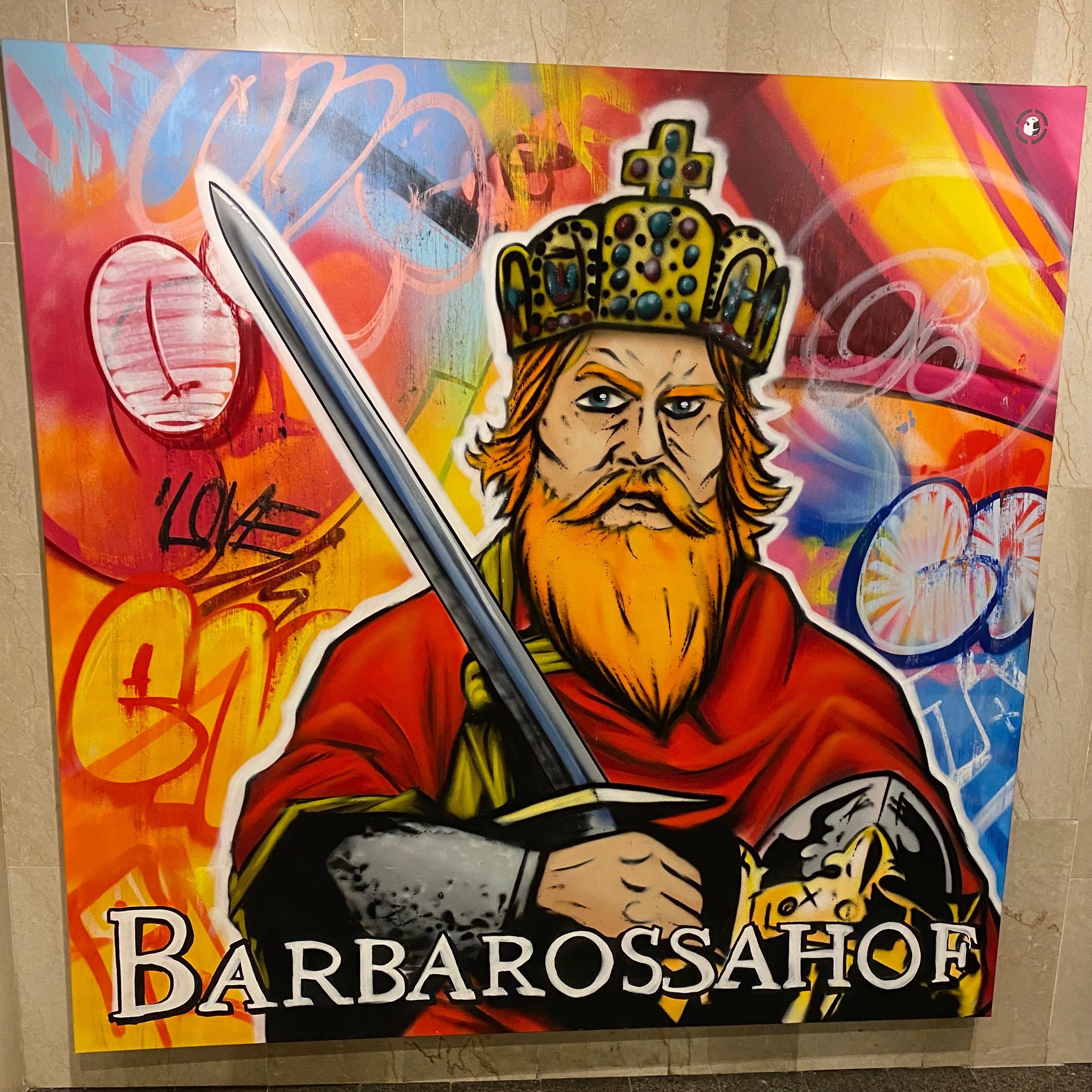
Sidenote: I finally looked up the meaning of Kaiserslautern after years of wondering idly, and it comes from the name of a local stream, the Lauter, and the fact that a medieval emperor, or kaiser, built a palace beside it. Said Emperor Barbarossa was who our lovely family-owned hotel was named after, and they had this surprising depiction of him in their basement.
I’ve been through the area many times over the past 18 years, but usually in lodging on Landstuhl and getting out as soon as possible after medical appointments.
Characteristically, there were many large recycling bins along the main walking paths. Each was a pair, one for green matter (full of old plants removed to keep graves looking nice) and one for the grow-pots that people bring in new plants in. They themselves were unsightly, but I only spotted one carelessly dropped pot in the whole place. (I recycled it; when in Germany &c.)
Not sure I can articulate this well: this essay feels like a gentle invitation into both your grief and also my own, not as gruesome morbidity, but as a blessed commonality with Christ. I often think on Christ entering into our grief, but never the other way around until now. It is a different and deep sort of comfort.
So sorry for loss. You write very well.